Blogs
Stationary Concrete Batching Plant
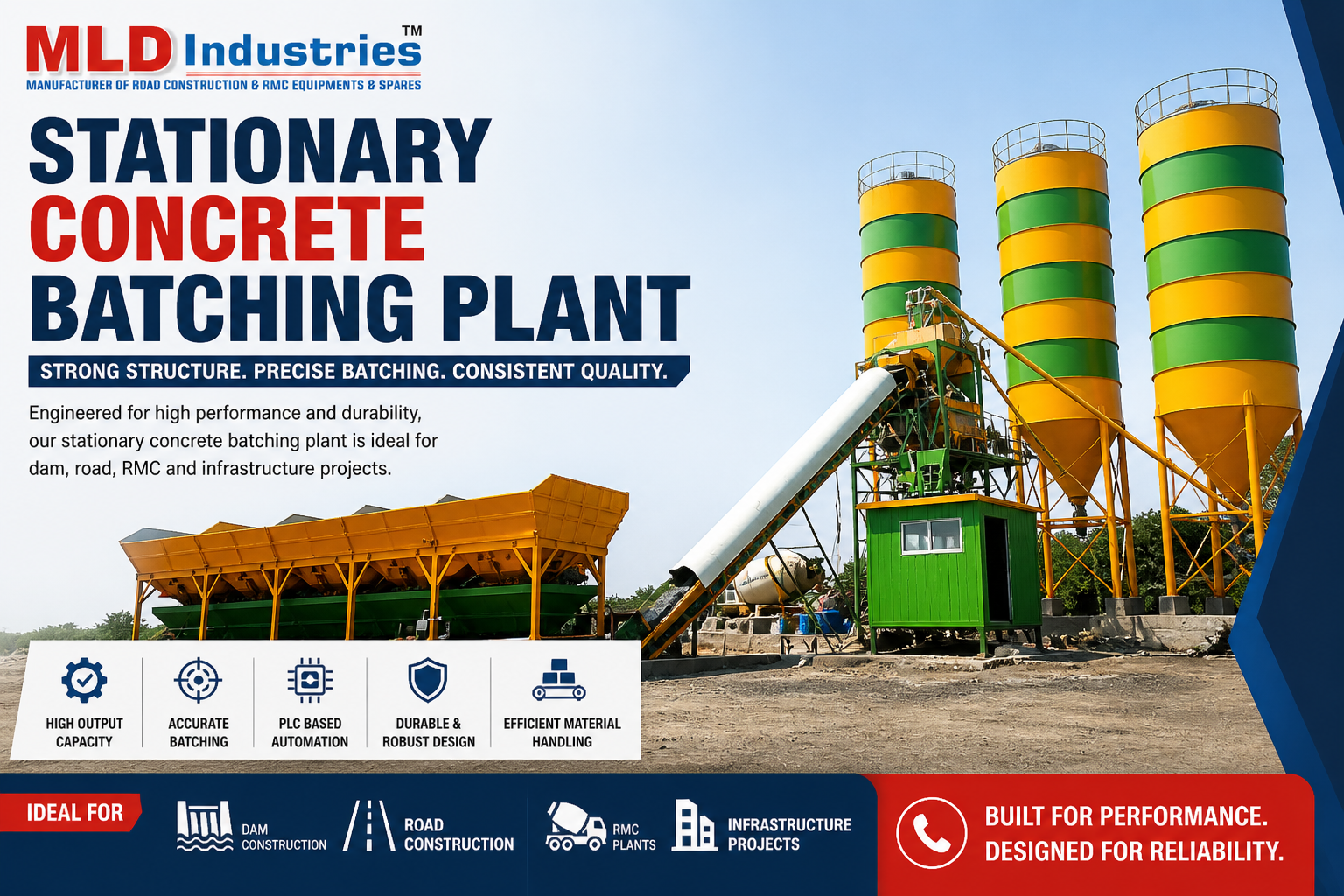
Stationary Concrete Batching Plant
A stationary concrete batching plant is an important machine for construction projects where continuous concrete production, accurate batching, and consistent quality are required. It is widely used in dam construction, road projects, RMC plants, bridges, industrial foundations, and large-scale infrastructure work. For contractors and project companies, this plant helps maintain concrete quality while improving production speed, site coordination, and operational efficiency.
MLD Industries manufactures construction and road equipment, including stationary concrete batching plants, asphalt drum mix plants, RMC plants, WMM plants, bitumen sprayers, and road sweepers. The company’s stationary concrete batching plant is designed for dam and road applications, with a focus on high-output capacity, precision mixing, automated control, efficient material handling, and reliable performance.
In modern construction, concrete quality cannot depend only on manual mixing or rough estimation. Every batch needs the correct proportion of aggregate, cement, water, and additives. A stationary concrete batching plant helps achieve this through proper weighing systems, controlled mixing arrangements, and an organized material transfer process.
What Is a Stationary Concrete Batching Plant?
A stationary concrete batching plant is a fixed concrete production system used to prepare concrete in controlled batches. It combines materials such as aggregates, cement, water, and additives in the required proportion and mixes them to produce uniform concrete.
Unlike mobile batching plants, stationary plants are installed at one project location for long-term use. They are suitable for sites where concrete demand is regular, production volume is higher, and the plant does not need to be shifted frequently from one location to another.
A stationary plant generally includes aggregate storage bins, a cement feeding system, conveyor belts, weighing hoppers, a mixer unit, control panel, water weighing system, additive weighing system, and supporting equipment. These components work together to support smooth batching, mixing, and concrete discharge.
For dam, road, and infrastructure projects, this type of plant provides better process control, which is essential for maintaining concrete strength, workability, and consistency.
Why Stationary Concrete Batching Plant Is Important for Construction Projects
Concrete is a major part of most construction work. If the concrete mix is not consistent, it can affect the strength, finishing, durability, and long-term performance of the structure. This is why controlled batching is important for serious construction projects.
A stationary concrete batching plant helps reduce variation in concrete production. It ensures that materials are measured accurately and mixed properly before discharge. This reduces dependency on manual methods and supports better quality control.
For large projects, time management is also important. When concrete production is slow or irregular, site progress can be delayed. A properly installed batching plant supports planned production and helps contractors manage concrete supply according to site requirements.
It is especially useful when the project requires repeated concrete batches with similar mix designs. This makes the plant suitable for road construction, dam work, bridges, industrial construction, and ready-mix concrete supply.
Stationary Concrete Batching Plant for Dam Construction
Dam construction requires a large quantity of concrete with consistent strength and durability. Since dams are long-term infrastructure projects, concrete quality plays a major role in structural safety and performance.
A stationary concrete batching plant is suitable for dam applications because it can be installed close to the project site and used for continuous concrete production. It helps manage large concrete demand while maintaining control over material proportion and mixing quality.
In dam projects, the batching plant must support efficient aggregate handling, proper cement feeding, accurate water measurement, and reliable mixing. Automated control systems also help reduce human error and improve operational consistency.
MLD Industries’ stationary concrete batching plant is designed for dam and road applications and supports high-demand construction needs with steady operation and precision mixing technology.
Stationary Concrete Batching Plant for Road Construction
Road construction projects often require concrete for rigid pavements, culverts, drains, bridges, underpasses, side structures, and other related civil works. In such projects, regular concrete availability helps maintain site progress.
A stationary concrete batching plant supports road construction by producing concrete in a planned and controlled manner. Since the plant is fixed at one site, it can serve continuous project demand without frequent relocation.
Road projects need practical equipment that can handle material movement, weighing, mixing, and discharge efficiently. Components such as aggregate bins, conveyor belts, cement weighing systems, water weighing systems, and PLC-based controls help maintain production flow.
For contractors handling long-duration road projects, a stationary batching plant can improve workflow, reduce mixing inconsistencies, and support better site coordination.
Main Components of a Stationary Concrete Batching Plant
A stationary concrete batching plant includes several important components that work together to produce concrete. Each component has a specific role in batching and mixing.
Key components include:
- • Aggregate storage bins for holding different sizes of aggregates
- • Aggregate weighing system for measured material feeding
- • Cement storage and screw conveyor for cement transfer
- • Cement weighing hopper for accurate cement quantity
- • Water weighing system for controlled water addition
- • Additive weighing system for chemical admixtures
- • Pan mixer or twin shaft mixer for concrete mixing
- • Material transfer conveyor for smooth aggregate movement
- • PLC-based control panel for process management
- • Air compressor for pneumatic operation support
When these systems are properly designed and maintained, the plant can produce consistent concrete with less manual error and better production efficiency.
Technical Specifications and Model Selection
Selecting the right stationary concrete batching plant depends on project requirements. Capacity, mixer type, power requirement, aggregate storage, cement handling, water weighing, and automation level should be checked before final selection.
MLD Industries provides stationary concrete batching plant models such as ST30 and ST45. The ST30 model has a plant capacity of 30 Cum/hr, while the ST45 model has a plant capacity of 45 Cum/hr. Both models include pan mixer or twin shaft mixer options, inline aggregate storage, screw conveyor cement feeding system, cement weighing hopper, water weighing system, additive weighing system, PLC-based control panel, and air compressor.
A 30 Cum/hr model can be suitable for medium production requirements, while a 45 Cum/hr model can support higher output needs. The final selection should depend on project size, working hours, concrete demand, site layout, and available power.
Instead of selecting only by capacity, buyers should also evaluate long-term usage, service support, ease of maintenance, and compatibility with project conditions.
Benefits of Stationary Concrete Batching Plant
A stationary concrete batching plant provides several practical benefits for construction companies, contractors, and concrete producers.
- • Helps maintain consistent concrete quality
- • Supports continuous concrete production
- • Improves accuracy in cement, aggregate, water, and additive batching
- • Reduces manual mixing dependency
- • Suitable for long-duration construction projects
- • Useful for dam, road, bridge, RMC, and infrastructure work
- • Supports organized material handling at site
- • Improves production planning and site workflow
- • PLC-based control improves operational accuracy
- • Helps reduce wastage caused by uncontrolled batching
These benefits make stationary batching plants useful for projects where concrete quality, production volume, and process control are important.
Role of PLC-Based Control Panel
Modern batching plants use automation to improve accuracy and reduce manual errors. A PLC-based control panel helps manage batching operations, material weighing, mixing cycles, and the discharge process.
In construction projects, even a small variation in material proportion can affect concrete consistency. PLC control helps operators follow the required process and maintain more uniform output.
Automation also improves speed and monitoring. It allows the operator to manage the plant from a centralized control system instead of manually controlling every stage. This is especially useful for projects where concrete production is continuous and time-sensitive.
MLD Industries’ stationary concrete batching plant includes a PLC-based control panel as part of its specification, supporting better operational control and batching accuracy.
Applications of Stationary Concrete Batching Plant
Stationary concrete batching plants are used in many construction and infrastructure sectors. They are suitable for projects where concrete is required in regular quantity over a longer period.
Common applications include:
- • Dam construction projects
- • Road and highway construction
- • Ready-mix concrete production
- • Bridge and flyover construction
- • Industrial foundation work
- • Commercial building construction
- • Canal and irrigation projects
- • Infrastructure development projects
- • Large residential construction sites
- • Concrete supply for civil engineering work
The plant is especially useful when the construction site needs better control over concrete production, mix design, and delivery planning.
How to Choose the Right Stationary Concrete Batching Plant
Choosing the right batching plant requires a clear understanding of project needs. A plant should not be selected only because of its output capacity. The buyer should check whether the complete system matches the project’s concrete demand and working conditions.
Important selection factors include:
- • Required concrete output per hour
- • Type and capacity of mixer
- • Aggregate storage arrangement
- • Cement feeding and weighing system
- • Water and additive weighing accuracy
- • Conveyor type and transfer system
- • PLC control and automation features
- • Total connected power requirement
- • Space available for installation
- • Maintenance access and spare parts support
- • Manufacturer experience in construction equipment
A well-selected plant can improve productivity and reduce operational problems. For long-term projects, it is also important to choose a manufacturer that provides reliable technical support and practical equipment design.
Maintenance Requirements for Better Performance
A stationary concrete batching plant works with cement, aggregates, water, additives, conveyors, motors, weighing systems, and control equipment. Regular maintenance is necessary to keep the plant working smoothly.
Operators should inspect the mixer, conveyor belt, screw conveyor, weighing hoppers, air compressor, electrical connections, control panel, and lubrication points. Cement buildup, aggregate spillage, and worn components should be cleaned or repaired on time.
Routine maintenance helps reduce breakdowns and improves the life of the plant. It also supports consistent concrete quality because properly functioning weighing and mixing systems are essential for accurate batching.
For busy construction sites, maintenance should be planned as a regular activity instead of waiting for machine failure.
Why MLD Industries for Stationary Concrete Batching Plant
MLD Industries offers a range of road and construction machinery, including asphalt drum mix plants, RMC plants, WMM plants, bitumen sprayers, road sweepers, and stationary concrete batching plants. The stationary concrete batching plant is designed for dam and road applications with durable components, automated controls, and efficient material handling systems.
The company provides models with practical production capacities and key features required for construction applications. Its plant specifications include pan mixer or twin shaft mixer options, inline aggregate bin system, screw conveyor, cement weighing hopper, water weighing hopper, additive weighing system, PLC control panel, and air compressor.
For buyers, the main value lies in choosing equipment that supports consistent production, better control, and long-term performance on construction sites.
Conclusion
A stationary concrete batching plant is a reliable solution for projects that need controlled concrete production, accurate batching, and continuous operation. It is especially useful for dam construction, road projects, RMC production, bridges, industrial foundations, and large infrastructure work.
With proper plant selection, automation, and maintenance, contractors can improve concrete consistency, reduce manual dependency, and manage project timelines more effectively. MLD Industries provides stationary concrete batching plant solutions designed for dam and road applications, with models and specifications suitable for practical construction needs.
FAQs
Contact Us
Address 82, Nandanvan Industrial Park 1, Near Rudra Industrial Park, Bakrol Dhamatvan Road, Bakrol (Bujarang), Ahmedabad-382433. Email mldind11@gmail.com Phone 8511101717, 9913544455Relevant SEO Tags
Filter Using Blog Tags