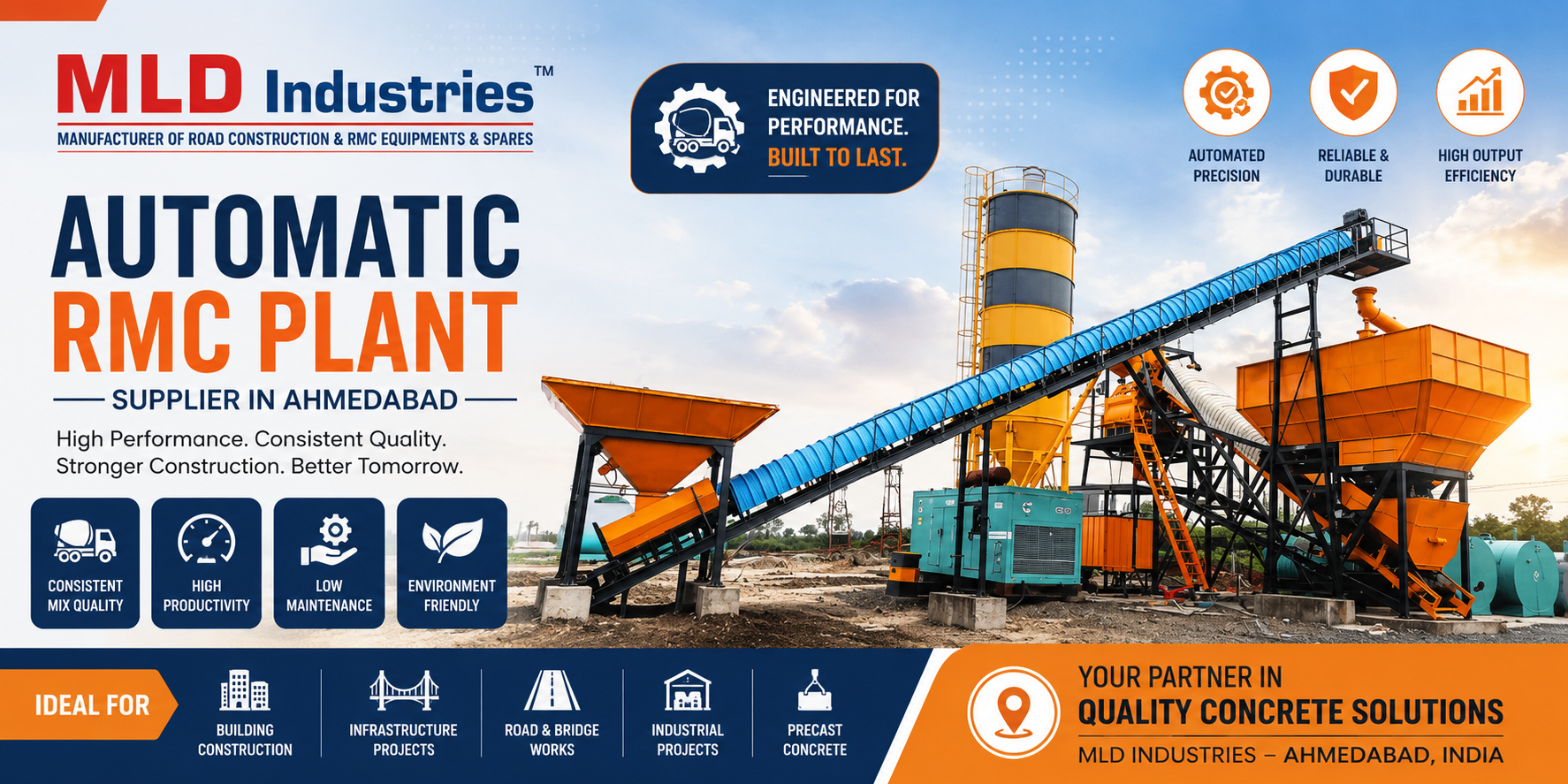
Automatic RMC Plant Supplier
Reliable automatic RMC plant supplier in Ahmedabad. Discover MLD Industries' quality plants for efficient concrete production and construction projects.
Why This Matters in Ahmedabad
Ahmedabad's dynamic urban development and infrastructure expansion projects necessitate a steady supply of high-grade concrete. The city's rapid industrialization and commercial growth, coupled with ongoing government initiatives for infrastructure upgrades, place immense pressure on construction timelines and material quality. Choosing a local, dependable automatic RMC plant supplier ensures that projects benefit from reduced transportation times, localized support, and a deep understanding of regional construction needs. This local advantage is critical for maintaining project momentum and adhering to stringent quality standards in a bustling metropolitan area.
What is an Automatic RMC Plant — Overview
An automatic Ready Mix Concrete (RMC) plant is a sophisticated facility designed for the precise and efficient production of concrete. It automates the weighing, mixing, and batching processes, minimizing human error and ensuring consistent quality. Raw materials like cement, aggregates (sand and gravel), water, and admixtures are stored in designated bins. The plant's control system automatically measures the correct quantities of each component according to a pre-set mix design. These ingredients are then conveyed to a mixer, where they are blended thoroughly to produce homogenous concrete. The finished RMC is then loaded into transit mixers for delivery to construction sites.
Key Features and Technical Specifications
- Automated Batching Control: PLC-based systems for precise ingredient measurement and mix control.
- High-Efficiency Mixer: Twin-shaft or planetary mixers designed for rapid and uniform blending.
- Robust Aggregate Storage: Multiple hoppers with controlled discharge for various aggregate sizes.
- Integrated Cement Silos: Secure storage for cement with screw conveyors for feeding.
- Admixture Dosing System: Accurate and automated addition of chemical admixtures for specific concrete properties.
- Modular Design: Facilitates easier transportation, installation, and future expansion.
- Advanced Dust Collection: Systems to minimize environmental impact and improve site safety.
- User-Friendly Interface: Intuitive control panel for easy operation and monitoring.
Industrial Applications and Use Cases
- Large-Scale Infrastructure Projects: Supplying concrete for bridges, highways, dams, and tunnels.
- High-Rise Building Construction: Providing consistent concrete for foundations, columns, and slabs in urban developments.
- Residential Housing Developments: Ensuring quality concrete for individual homes and multi-unit dwellings.
- Commercial and Industrial Buildings: Meeting the specific strength and durability requirements for factories, warehouses, and retail spaces.
- Precast Concrete Manufacturing: Producing standardized concrete elements like beams, pipes, and panels.
- Road Construction and Paving: Delivering specialized concrete mixes for road surfaces and related structures.
- Airport and Port Development: Supplying high-performance concrete for runways, taxiways, and terminal facilities.
- Specialty Concrete Applications: Producing self-compacting concrete, fiber-reinforced concrete, or colored concrete.
How to Choose the Right Automatic RMC Plant
Selecting the appropriate automatic RMC plant is a critical decision that impacts project efficiency and profitability. Consider these factors:
- Production Capacity: Determine the required output volume per hour based on your project needs and potential future demand.
- Plant Type: Decide between stationary plants (for long-term, high-volume sites) or mobile plants (for flexibility and remote locations).
- Automation Level: Assess the sophistication of the control system and its ability to handle complex mix designs and reporting.
- Component Quality: Verify the specifications and brands of key components like mixers, motors, and control systems.
- Supplier Reputation and Support: Research the manufacturer's track record, customer reviews, and the availability of after-sales service and spare parts.
- Customization Options: Ensure the plant can be configured to meet specific site requirements or unique mix design needs.
- Compliance and Certifications: Confirm that the plant meets relevant industry standards and environmental regulations.
- Ease of Operation and Maintenance: Evaluate the user-friendliness of the control interface and the accessibility for routine maintenance.
Quality Standards and Compliance
For any automatic RMC plant supplier, adherence to stringent quality standards and regulatory compliance is non-negotiable. Reputable manufacturers ensure their plants are built to meet or exceed national and international standards such as ISO certifications for quality management systems. Specific components might adhere to standards like IS (Indian Standards) for aggregates, cement, and admixtures. The plant's design should also consider environmental regulations regarding dust emissions and noise pollution, often requiring specific dust collection systems and operational protocols. Buyers should always verify the certifications of the plant manufacturer and ensure that the plant's operational parameters align with the required concrete grades as per IS codes for construction.
Why MLD Industries' Experience and Capability Matters
MLD Industries, with its foundation laid by Mr. Poonam Panchal's three decades of expertise and guided by CEO Mr. Jaimin Panchal's decade of experience, brings a profound understanding of the road construction and concrete production sector. This deep-rooted industry knowledge translates into manufacturing robust and reliable automatic RMC plants tailored to the demanding Indian construction environment. Our manufacturing processes emphasize precision engineering and the use of high-quality components, ensuring durability and consistent performance.
Our technical team possesses the expertise to design and fabricate plants that meet diverse capacity requirements and complex mix designs. We understand that quality control is paramount, and our plants are built with rigorous testing protocols at every stage. MLD Industries is committed to providing not just equipment, but comprehensive solutions, offering customization to fit specific site needs and ensuring timely delivery. Our dedication extends to reliable after-sales support, ensuring your RMC operations run smoothly and efficiently.
Installation, Maintenance, and Care Tips
Proper installation and regular maintenance are crucial for the longevity and optimal performance of your automatic RMC plant. Upon delivery, ensure the site is prepared according to the manufacturer's specifications, including a stable foundation and adequate power supply. Professional installation by MLD Industries' trained technicians is recommended to guarantee correct setup and calibration.
Routine maintenance should include daily checks of lubrication points, cleaning of mixer blades and chutes, and inspection of conveyor belts. Weekly tasks may involve checking hydraulic fluid levels, inspecting electrical connections, and verifying the calibration of load cells. Monthly maintenance should encompass a more thorough inspection of the entire system, including wear parts in the mixer, and calibration checks of all sensors. Adhering to a strict maintenance schedule, as outlined in the plant's manual, will prevent unexpected breakdowns and ensure consistent concrete quality.
Frequently Asked Questions
Automatic RMC plants come in a wide range of capacities, typically measured in cubic meters per hour (m³/hr). Common capacities range from 30 m³/hr for smaller operations to over 200 m³/hr for large-scale projects. The specific capacity needed depends on the project's concrete demand, delivery logistics, and the number of transit mixers available.
The batching process in an automatic RMC plant is highly accurate due to the use of sophisticated PLC-based control systems and calibrated load cells or weigh-batchers. These systems ensure that each ingredient—cement, aggregates, water, and admixtures—is measured to within a very tight tolerance, typically ±1% to ±2%, ensuring consistent concrete quality.
Regular maintenance is essential. This includes daily cleaning of the mixer and discharge area, lubrication of moving parts, and checking fluid levels. Weekly tasks involve inspecting wear parts like mixer blades and belts, while monthly checks should include calibration of sensors and a comprehensive system inspection. Following the manufacturer's maintenance schedule is key.
Yes, automatic RMC plants are designed for versatility. The advanced control systems allow operators to program and store numerous mix designs, enabling the production of various concrete types, including different strength grades, workability levels, and specialized mixes with admixtures.
Key environmental considerations include dust control, noise reduction, and proper waste management. Reputable plants are equipped with dust suppression systems, such as bag filters or water sprays, at loading and mixing points. Noise levels are managed through plant design and operational practices. Proper disposal of wash water and concrete spillage is also crucial.
Operating an automatic RMC plant requires trained personnel. Operators need to understand the control system interface, mix design programming, material handling procedures, and basic troubleshooting. Maintenance staff require specialized training in mechanical, electrical, and hydraulic systems specific to the plant model.
Conclusion
For construction projects in Ahmedabad, partnering with a reliable automatic RMC plant supplier like MLD Industries is crucial for achieving project success. The efficiency, consistency, and quality assurance provided by an automated system directly impact construction timelines and the structural integrity of buildings and infrastructure. Evaluating a supplier's experience, technical capability, adherence to quality standards, and commitment to after-sales support will ensure you select a plant that meets your specific needs and contributes positively to your operational goals.
Get In Touch
Mld Industries