Blogs
Compact plant for RMC manufacturer in India
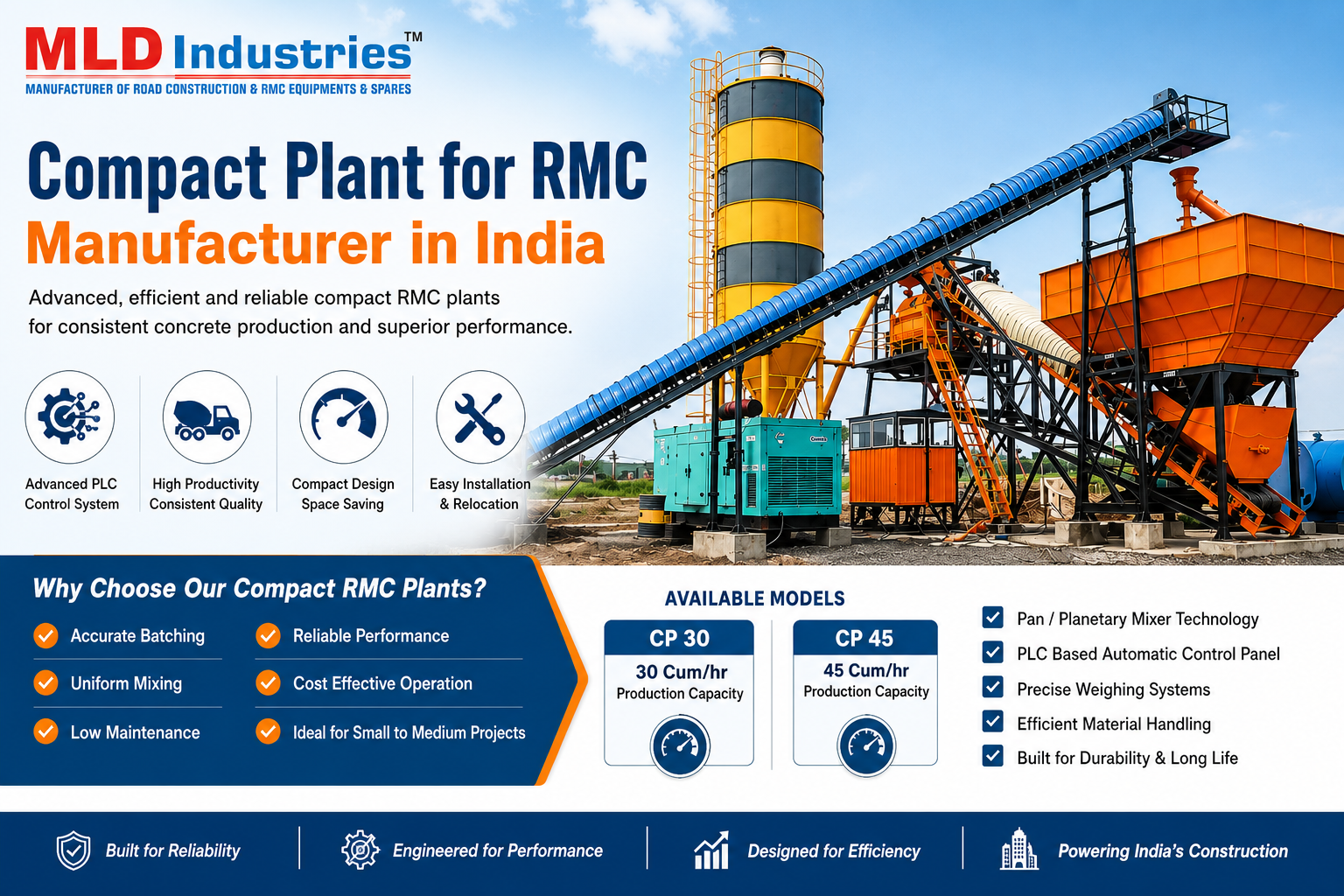
Compact Plant for RMC Manufacturer in India
The construction and infrastructure industry continues to demand reliable and efficient concrete production systems capable of supporting fast-paced project execution. A Compact Plant for RMC plays a critical role in meeting these requirements by delivering consistent concrete production, precise batching operations, and efficient material handling within a compact and space-saving structure. These plants are widely used across residential, commercial, industrial, and infrastructure projects where reliable concrete production is essential.
A compact ready-mix concrete plant is specifically designed to optimize production efficiency while reducing installation space and operational complexity. Contractors and infrastructure developers prefer these systems because they provide accurate batching, uniform concrete mixing, and dependable performance suitable for modern construction requirements.
According to the product details provided by MLD Industries, the Compact Plant for RMC is designed for small to medium-scale concrete production and includes advanced batching technology, user-friendly operation, and easy relocation capability.
Understanding Compact Plants for RMC
A Compact Plant for RMC is an integrated batching and mixing system used to produce ready-mix concrete efficiently. Unlike large stationary batching systems, compact plants combine multiple operational components into a modular and space-efficient design. These plants generally include aggregate storage compartments, conveyor systems, cement feeding units, water weighing systems, additive systems, and automated control panels.
The primary purpose of a compact RMC plant is to maintain consistent concrete quality while improving operational productivity. These systems are suitable for projects requiring a reliable concrete supply in limited installation areas.
Modern compact batching plants are engineered to support accurate material measurement, automated mixing operations, and continuous concrete production while minimizing material wastage and operational downtime.
Working Process of a Compact RMC Plant
The operation of a compact ready-mix concrete plant follows a systematic batching and mixing process. Aggregates are stored in dedicated compartments and transferred through conveyor systems into the mixer. Cement, water, and additives are measured using automated weighing systems to maintain batch consistency.
The materials are mixed uniformly inside a pan mixer or planetary mixer to produce concrete with the required strength and workability. Automated PLC-based control systems monitor the entire process and help operators manage production cycles efficiently.
This controlled batching process improves concrete quality, reduces manual errors, and ensures reliable production performance across different construction applications.
Key Features of Compact Plants for RMC
Compact concrete batching plants are designed to deliver reliable performance while occupying less operational space. Their modular structure and automated functionality make them suitable for modern construction requirements.
Important features include:
- Compact and modular plant design
- Advanced PLC-based control systems
- Accurate aggregate and cement weighing
- Uniform concrete mixing performance
- Easy transportation and relocation
- Quick installation and commissioning
- Reduced material wastage
- Low maintenance requirements
- Consistent production quality
- Efficient power utilization
Technical Specifications and Plant Components
The technical structure of a compact RMC plant determines its operational efficiency and production capability. These systems generally include aggregate bins, conveyor belts, screw conveyors, mixers, weighing hoppers, additive containers, air compressors, and control systems.
The uploaded specification details mention models such as CP 30 and CP 45 with production capacities of 30 Cum/hr and 45 Cum/hr respectively. The plants include pan or planetary mixers, PLC-based control panels, aggregate weighing conveyors, cement weighing systems, and water dosing units designed for accurate batching operations.
The use of automated controls and efficient material handling systems helps improve productivity and maintain consistent concrete quality throughout the production process.
Applications of Compact RMC Plants
Compact ready-mix concrete plants are widely used in multiple sectors because of their flexibility, mobility, and efficient concrete production capability. Their compact footprint makes them highly suitable for urban and infrastructure projects.
Common applications include:
- Residential construction projects
- Commercial building construction
- Highway and road projects
- Bridge and flyover construction
- Industrial infrastructure development
- Smart city projects
- Urban infrastructure projects
- Precast concrete manufacturing
- Government civil engineering work
- Medium-scale ready-mix concrete production
Importance of Concrete Quality in Construction
Concrete quality directly affects the durability, stability, and long-term performance of any structure. Inconsistent batching or improper material measurement can reduce structural strength and increase maintenance concerns.
Compact RMC plants help maintain precise batching accuracy through automated weighing systems and controlled mixing operations. PLC-based automation minimizes human errors and improves batch consistency.
Uniform mixing ensures better compressive strength, improved workability, and consistent performance across construction applications. Reliable concrete production is especially important for infrastructure projects where structural integrity is a major requirement.
Advantages of Compact Design
One of the major advantages of compact RMC plants is their ability to operate efficiently in limited spaces. Urban construction projects often face installation constraints due to restricted site availability. Compact batching plants address these challenges through modular engineering and optimized plant layouts.
The compact structure also simplifies transportation and relocation between different project sites. Contractors handling multiple construction projects benefit from faster setup times and improved plant mobility.
Additionally, compact designs improve operational management by reducing site congestion and simplifying maintenance accessibility.
Role of Automation in RMC Plants
Automation has become a critical component in modern concrete batching systems. Compact plants equipped with PLC-based controls provide accurate monitoring of batching cycles, material consumption, and production operations.
Automated systems improve operational consistency by maintaining precise material ratios and reducing manual intervention. Operators can monitor real-time production data, identify system errors quickly, and manage production schedules more efficiently.
Automation also supports better resource utilization and helps reduce operational delays during continuous concrete production activities.
Environmental and Operational Benefits
Compact concrete batching plants contribute to cleaner and more efficient construction operations. Controlled batching systems help minimize material wastage and optimize cement consumption. Enclosed material handling systems reduce dust generation during operation.
Producing concrete directly at the construction site also reduces transportation dependency, fuel consumption, and logistical delays. This improves project efficiency while supporting environmentally responsible construction practices.
Lower installation requirements and optimized power utilization further contribute to operational cost efficiency and sustainable construction operations.
Factors to Consider Before Selecting a Compact RMC Plant
Choosing the right compact ready-mix concrete plant depends on project requirements, production capacity, and operational conditions. Construction companies and contractors should evaluate technical specifications carefully before selecting a batching system.
Important factors include:
- Required production output capacity
- Mixer type and mixing performance
- Automation and control system quality
- Aggregate storage capacity
- Ease of transportation and relocation
- Power consumption efficiency
- Maintenance accessibility
- Site installation requirements
- Operational reliability
- Technical service and support availability
Future Demand for Compact RMC Plants in India
India’s growing infrastructure sector, urban development projects, industrial expansion, and highway construction activities are increasing the demand for reliable concrete production systems. Compact plants for RMC are becoming increasingly important because they combine operational flexibility, accurate batching, and efficient concrete production within a smaller footprint.
As construction companies continue focusing on productivity, automation, and sustainable operations, compact batching systems are expected to witness strong demand across the ready-mix concrete industry.
Advanced control technologies, modular engineering, and efficient material handling systems will continue driving the adoption of compact RMC plants in modern construction projects.
FAQs
Filter Using Blog Tags